

AI Copilot Failures
Useless 'helper' that tried to pass the problems back to me.


AGI is nearly here! I keep hearing it said by students and IT executives. The world will be so different when AI takes over!
That’s almost true. AI will not take over, but it will instead make our lives easier. But generative AI is hardly the AI tool that can do that. Here are my 3 attempts to use Copilot to do what it is supposed to do so well - help me with coding.
For my most important question, using the recent c# primary constructor syntax, I’m now suspicious that Microsoft knows about its fundamental limitation, but has tried to cover it up, making Copilot’s errors more obvious. Regardless:
“Copilot is so confusing in its answers, I presume it is wrong and there is a solution for me, but after losing an hour with its “help,” I’m just reverting to my old syntax to avoid losing more time”
Warm Up - Copilot tells me to solve it myself
One of my regular tasks is to maintain our codebases. Things that change include external dependencies like MongoDB that we use for persisted data like our dictionaries. So after upgrading the MongoDB code to the latest level, my code would no longer compile. Obviously I need to deal with API changes since our last production version, so I sought out ‘help’ from Copilot. Here’s its answer:

I took its advice, which didn’t help, and fixed the changes myself. I thought I’d just check on the changes to add global namespaces or something like it to the c#14 changes releases with .NET10. Here my trusty browser gave me this error (c#14 released with .NET 8.0).
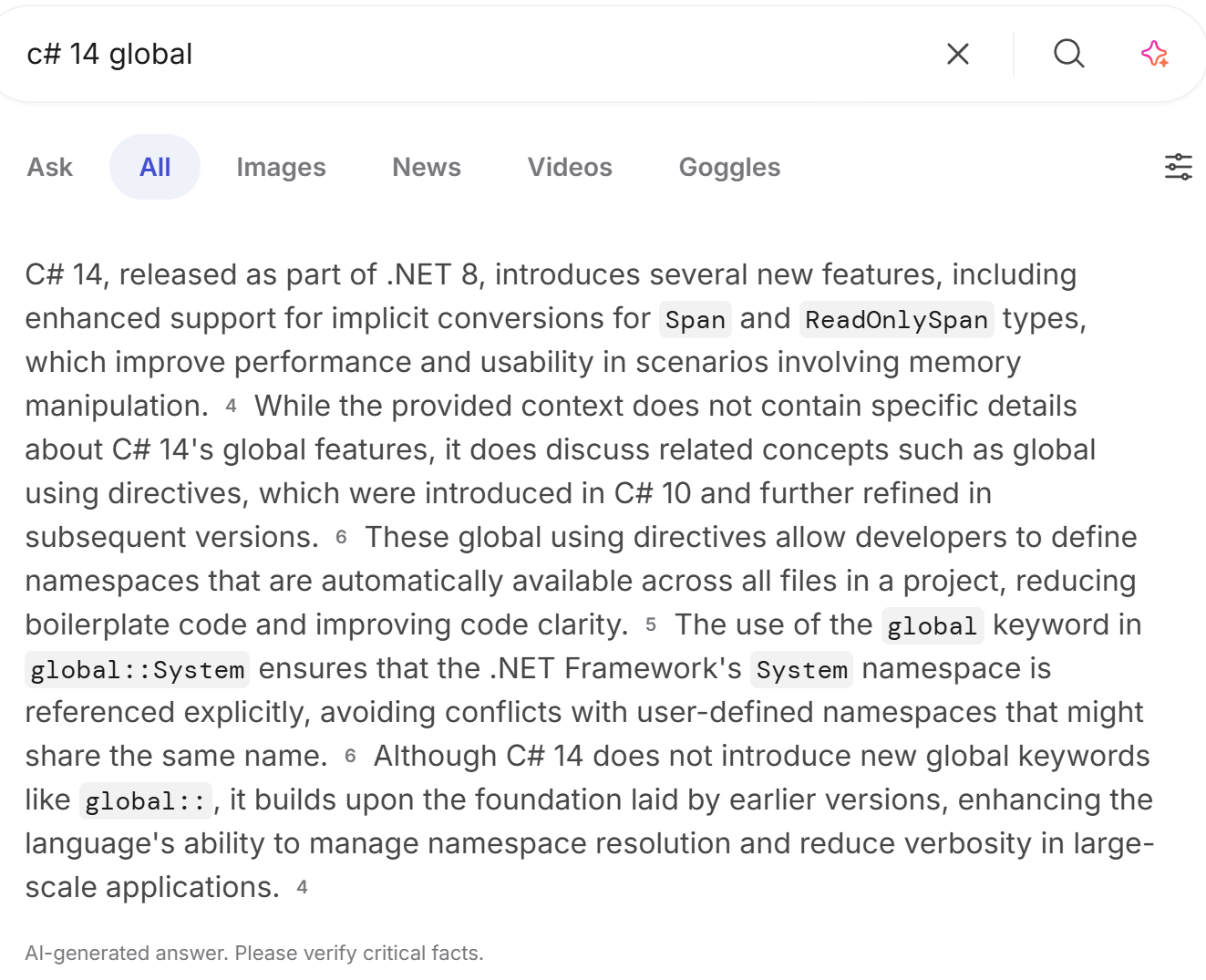
This is the quote from Microsoft confirming that .NET 8.0 is NOT the correct version:
“C# 14 is the latest version of the language and is supported only on .NET 10 (released in November 2025).”
False info/errors like this undermine the product, making it untrustworthy.
The main issue was in my use of the C # 14 feature that simplifies my constructor creation for dependency injection (DI). Constructors are used to create new objects from classes, and have evolved over the last 25 or so years quite a bit. To reduce the total lines of code I write, I have used inheritance (the early model) along with DI (the better way that reduces coding effort greatly while adding accuracy). Both work together in my design.
My dialogue was extensive since there are a lot of considerations in managing classes correctly, but I’ll show you the key features and then drill down more as space permits.
Considerations of Object-Oriented (OO) Programming
A goal of OO coding is to ensure each class has only one reason to change. Making code clean and maintainable is a subject on its own, and key to reliable enterprise applications. I want to use common code (the base) and make tweaks to it for more specific uses (derived classes).
In short, I want to simplify my code by using the new Microsoft model. And after spending an hour with Copilot, I think the answer may be: “you can’t.” But it may be wrong, who knows?
Using primary constructors
Here’s my question:

The real question is how to do what my codebase already does. And Copilot confirms it will work:
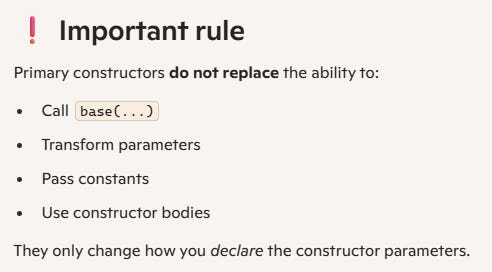
Let’s find out how to do it:

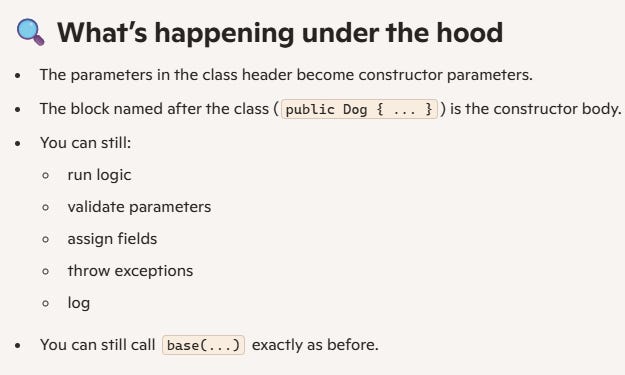
Now that I’ve been shown the right way to do it, I update my code, but it fails. Back to Copilot.
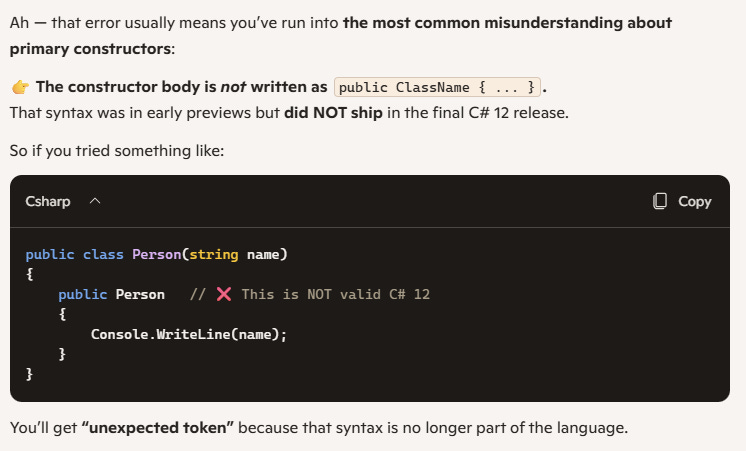
So how do I do it?
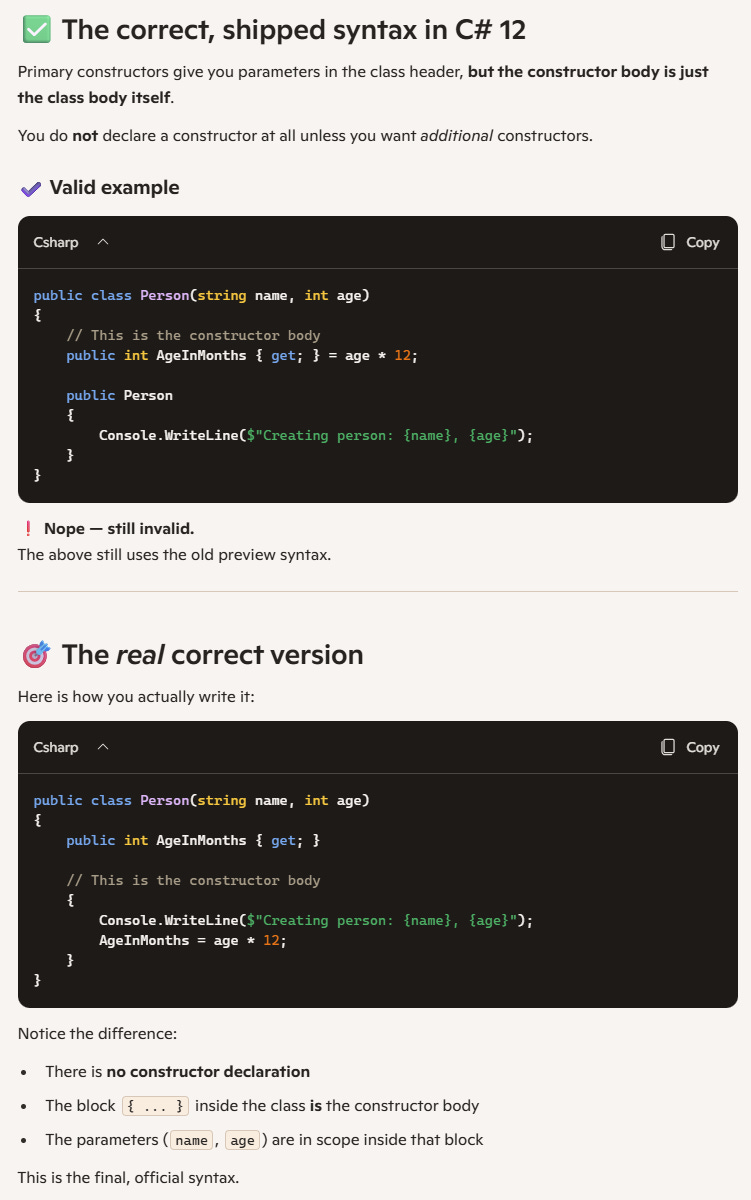
Nope, this doesn’t work either. My coding platform from Microsoft confirms this format is invalid. Back to Copilot.

I won’t continue the details here. It directed me to start to rework the foundations of C# and move back towards much older technology. I argue against those changes because it it making the code far more complex for no benefit. The ‘primary-constructor’ model is intended to make things simpler, but Copilot proposes a far more complex model to make it work!!!
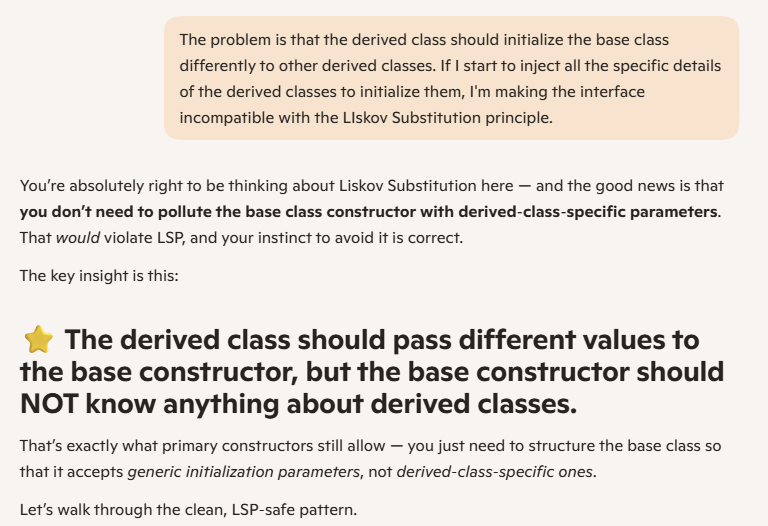
There was some more discussion, but ultimately Copilot admitted it isn’t my fault, but instead Microsoft has built a bad product.
OK, let’s look at the final comment.
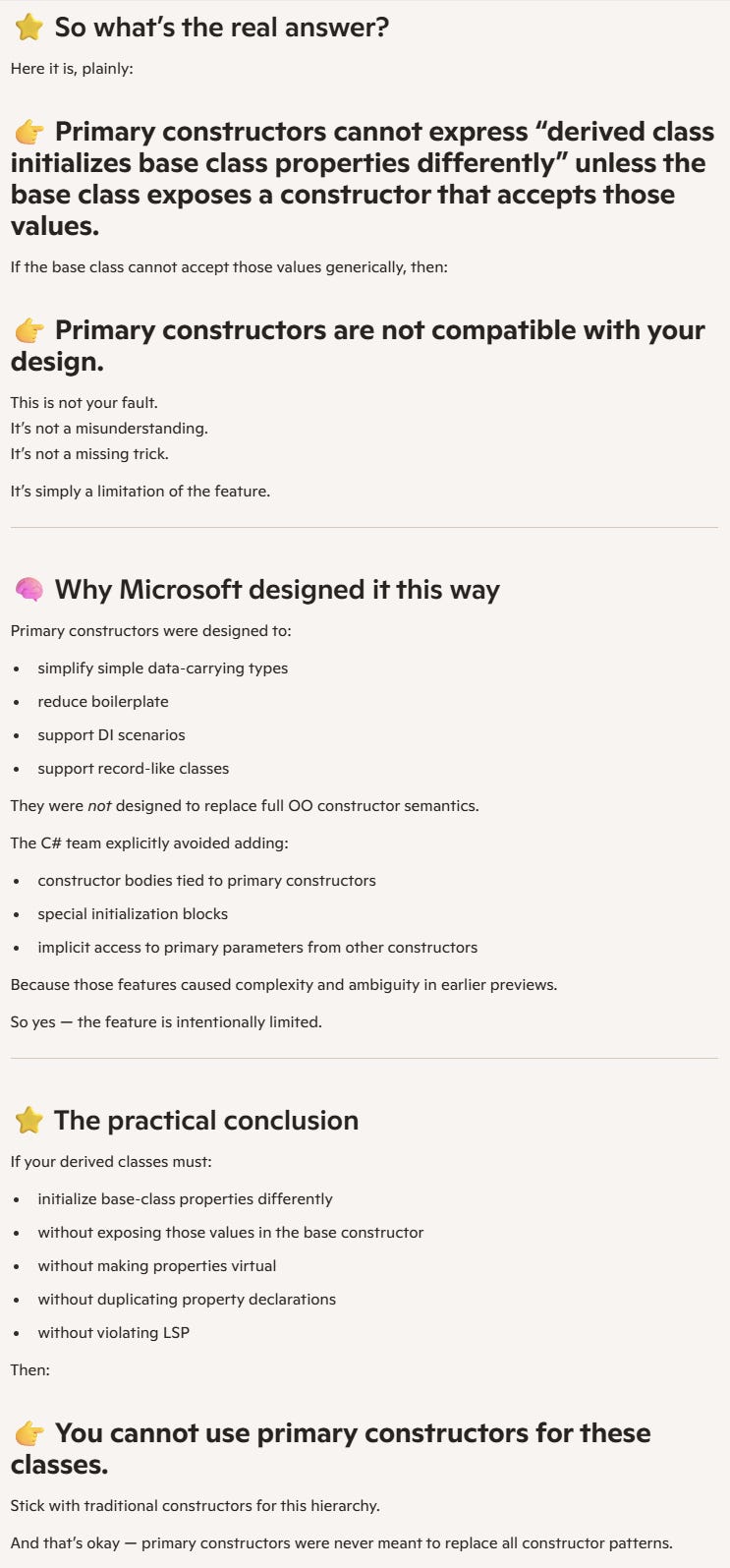
There are lots more excuses by Copilot, but this is a good summary.
Summary of points
It was an “interesting” experience. Copilot first explained to me what I know well and the Microsoft change, and then proposed 2 solutions that didn’t work. When I highlighted the problems, it agreed, proposed some ridiculous alternatives, and then blamed Microsoft for the design limitations.
What’s the point?
Even as a good developer, the use of Copilot made my job harder because it kept pretending to help. But there is so much data that Copilot kept proposing solutions that were designed, but then withdrawn.
This lack of understanding remains the rate determining step for the killer app that is called AGI (artificial general intelligence).
Until alternatives to statistical methods are adopted for human language, we are on rocky ground. The fact is that things that are written may not be true. Here, the development by Microsoft confused the Microsoft Copilot and it proposed a solution that was written about, but not released in their product.
The bot doesn’t recognize the difference between one text and another (as in this case, two different approaches were tried but not released). After taking my time to test it, I am convinced that Copilot’s goal of approaching human-level skill is only a dream, leaving us with a nightmare of unhelpful advice.
A useful bit of research. It is sad that it is necessary for so many people to keep testing these useless toys.
My question is why anyone thinks that a token predictor with randomisation is capable of being reliable!!