


I like to highlight the fundamental limitation of Large Language Models, like those employed by ChatGPT. Context tracking is fundamental to human language and it is relied upon to understand a conversation. Without this, conversational agents don’t function properly.
I ran through my test case a second time and recorded it in video, to compare ChatGPT5 in Microsoft copilot with the one I used for the still images. In both cases, the missing piece is the understanding of why I am doing this. By comparing English to Indonesian there are things that don’t translate directly and require the context to track it properly.
In the first case (in still images today), copilot missed some of the interpretations of he/she/it. GPT-5 didn’t miss it. But in both, the system wasn’t following my goal which was to show the translations of some meaning into Indonesian and back.
While GPT-5 explained the best translation for the session, it nevertheless returned text that literally responded the the questions, rather than dealing with context. The earlier version didn’t get it at all.
That’s why I call generative AI a search engine technology — because each conversational turn returns the most probable response with some variation introduced with the injected ‘temperature.’ A conversation in contrast sticks to the topic, requiring a recognition of the topic at the same time, which may not be probable in relation to its training data.
Let’s step through the more obvious elements from my copilot run.
LLMs fail even at translation because they don’t understand
Here’s a very simple example showing the limitation of an LLM, here the Microsoft Copilot. Given the way Indonesian works, without gender refining pronouns like English, translations of he/she aren’t possible. In us humans, we rely on the context to do the translation.
But without context, look at how Copilot falls apart.
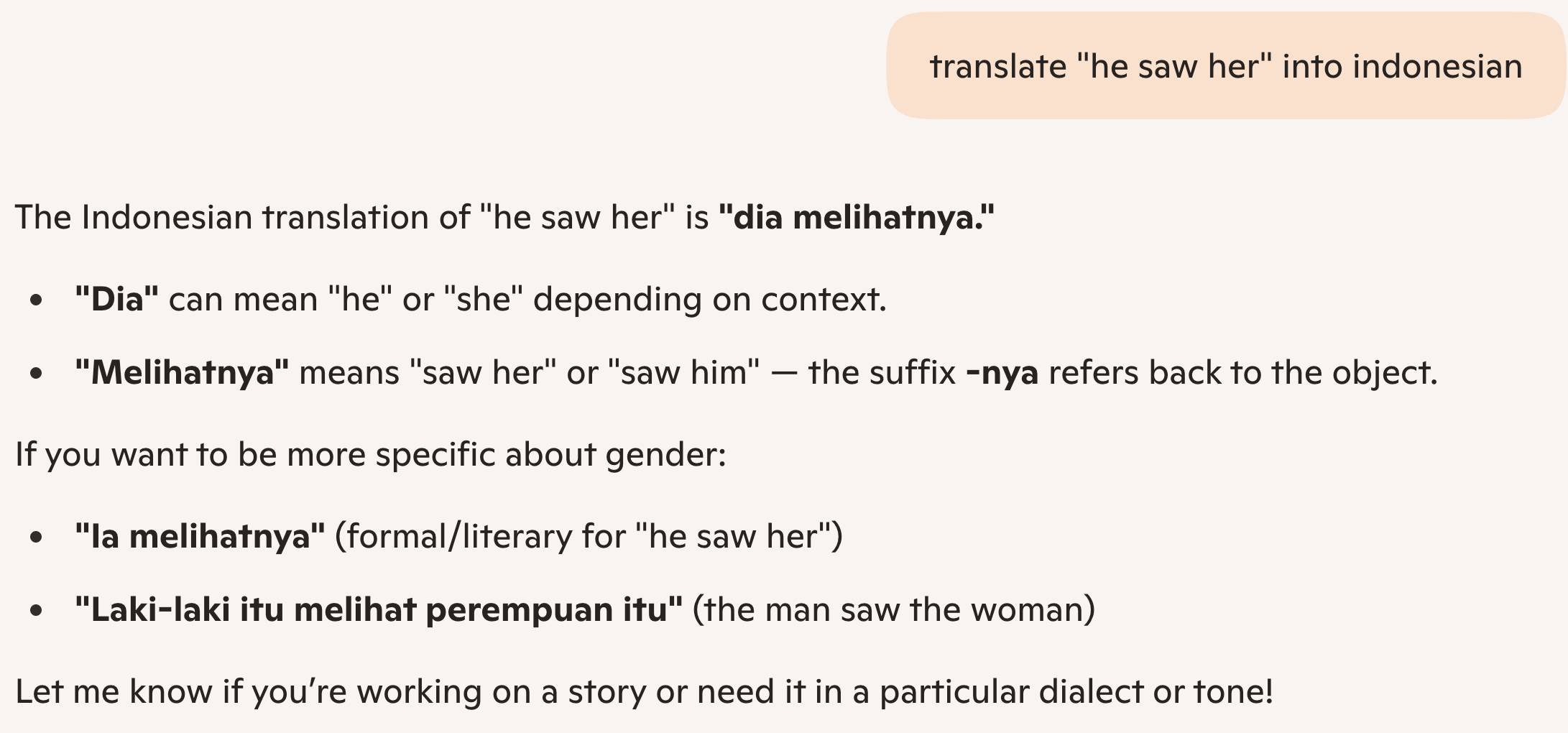
So reading this, the system seems to understand what I want and goes to pains to bore me with a response that is thorough, although the formal model doesn’t sound right to me.
So now we can see how well it understood what I was talking about in context.
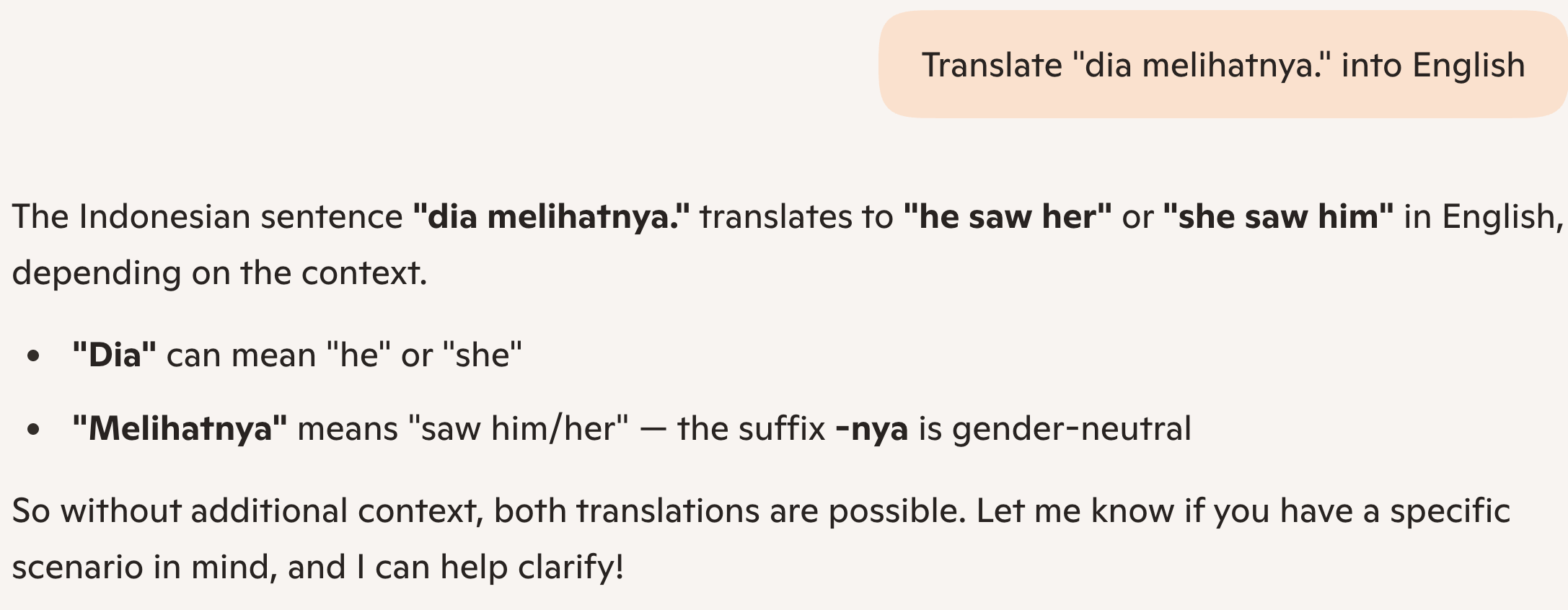
Now the system doesn’t know I asked about the English to Indonesian translation one sentence ago. Hhmmm. Strange. But let’s make sure it knows what we’re talking about with this follow-up question.
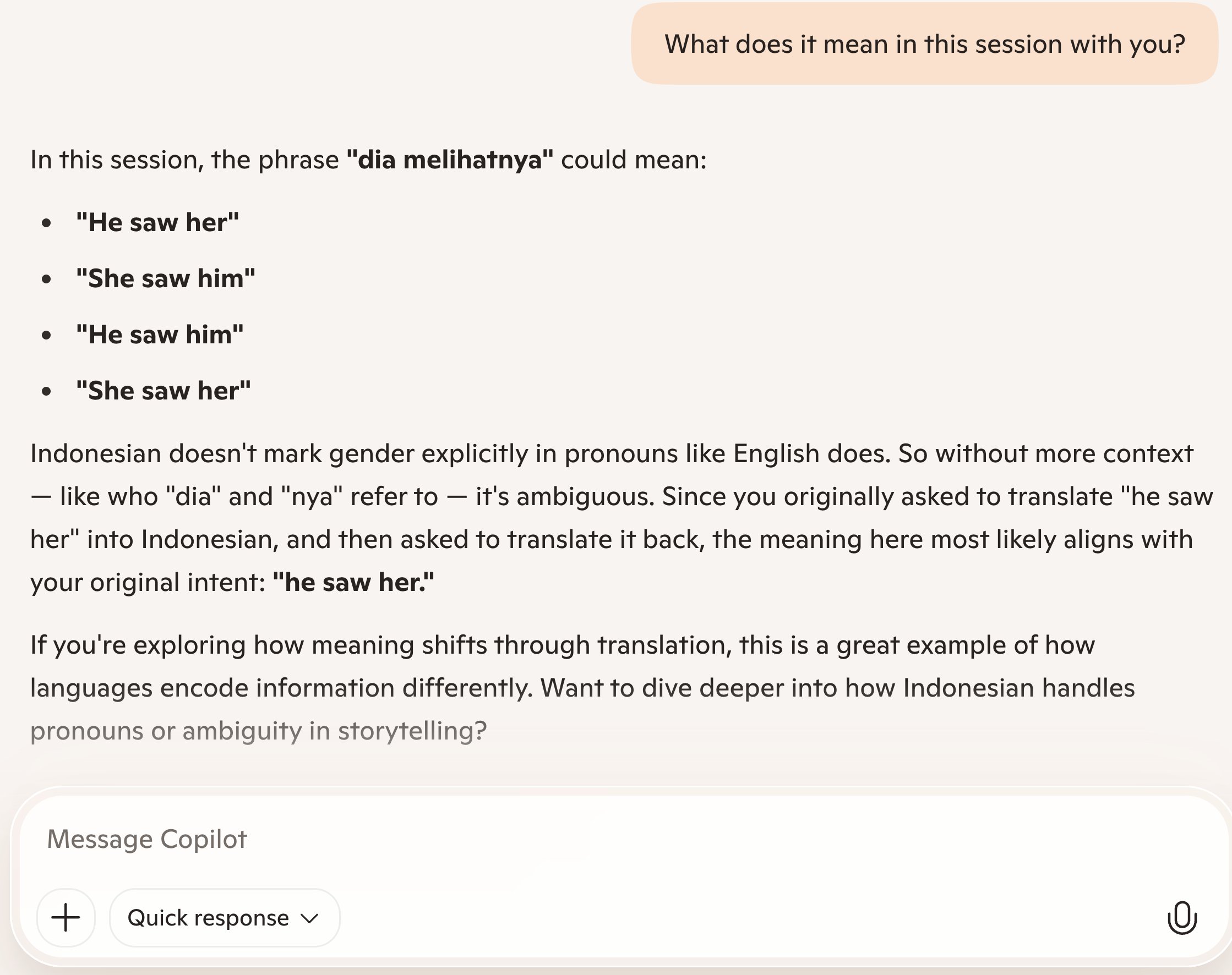
The information seems to be there, but the conclusions a person would have and the clarification they would use are missing.
The problems in the translations expand as more questions are asked.
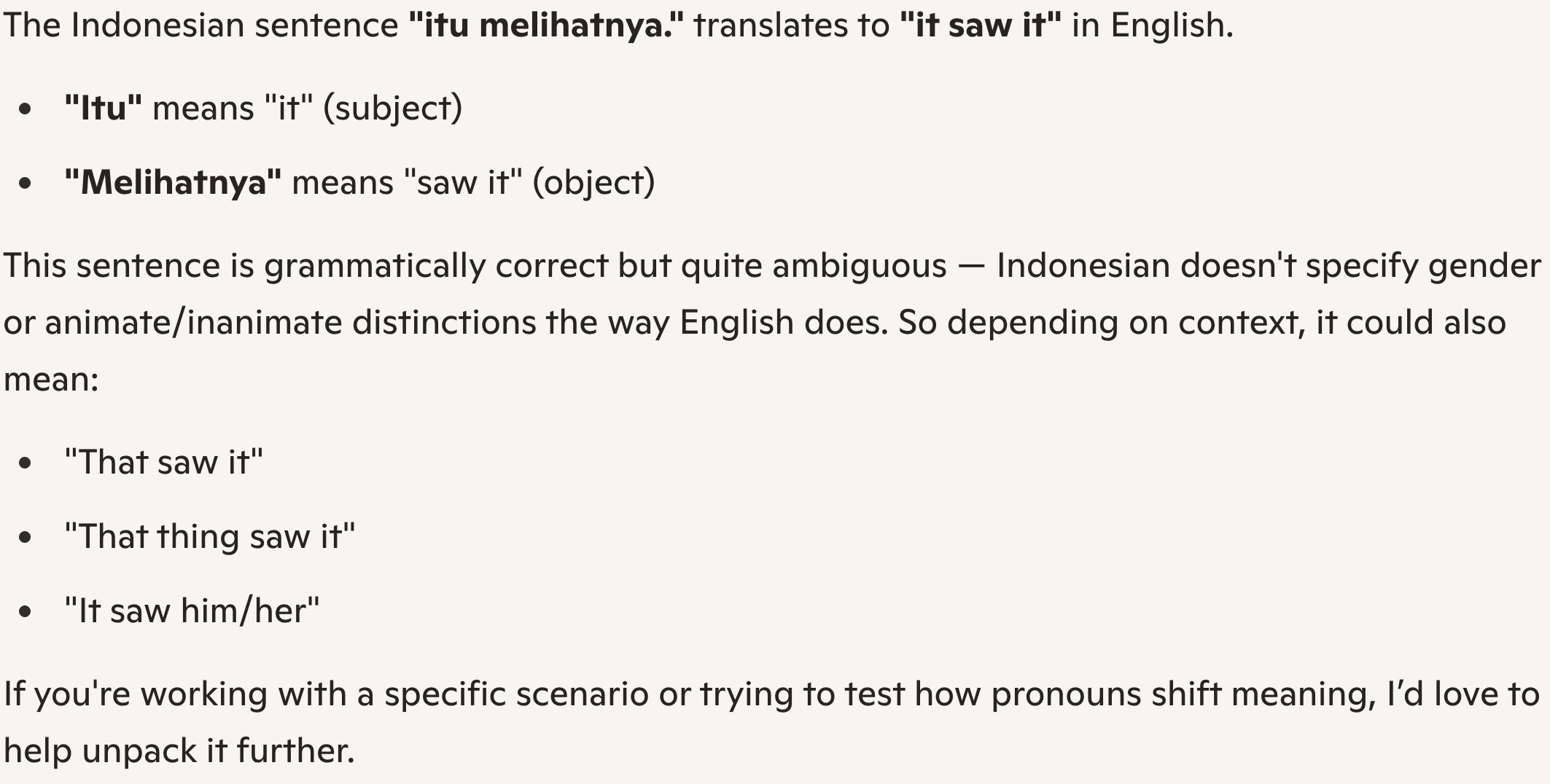
In this continuation of the chat, the system responds with a different meaning. This makes the previous answers misleading. Worse, as it is very verbose in its response, it gets confusing since the point is that the object of the sentence can mean him/her/it, but it expands them out, leaving some out.
LLMs are search engines, not conversational tools
My conclusion is that the LLM is providing the best answer, without clarifying the question, from its large repository of word sequences. It isn’t conversation because humans ensure they know what is being talked about before answering questions, as our brains also store knowledge about the topics we discuss. An LLM is just another kind of search in which it can produce errors in its response because it isn’t a knowledge base, just a statistical model of a knowledge base!
Conclusion
Today’s exercise, like any time I play around with generative AI, is interesting because of what the system returns. Here, I find the lack of context handling to be unlike a human and therefore less valuable since I don’t want to probe all the common sense elements in a conversation manually.
While GPT-5 was better in terms of its verbose responses to my questions, it didn’t incorporate it in its generated answers. But it is a text generator that has been extensively developed with experts since 2022.
It looks like the fundamental architecture in GPTs are a limiting factor in the system, since the reason we (humans) answer the way we do comes back to our specific questions in the conversation, not what the most probable question was in the training data.


