

LLMs fail without context
Context is key to human language


When we are children, we quickly master directions. Directions are flexible in most languages — and important. That flexibility allows for descriptions of spatial relationships in a myriad of ways - near, left, above, North of, and so on.
To read more on spatial languages, a great resource for such cognitive semantics was written by Leonard Talmy 25 years ago in his book, Toward a Cognitive Semantics. These relationships seem to have fixed meanings once learned, but rely closely on the context to remove ambiguity, if possible and recognize it otherwise.
C.S. Peirce had a great model more than 100 years ago
What’s interesting about navigation is how it relates to the C.S. Peirce signs. In his model, signs can be icons (things that resemble other things, like how maps resemble the world in spatial terms), indices (connection to their object) and symbols (connection to objects by convention).
For navigation, they are icons whose semantics relate objects in context with other objects in context or that need to be. This is least probable to work with today’s transformer architecture because each transformer token is mapped to a word vector - a little like catering to symbols, a little for indices to relate proforms, but not icons.
Let’s test Microsoft Copilot
Saying, “I’m next to my friend” suggests they are either to the left or right of you. If you’re facing North, they are either East or West of you. There are many permutations, and ‘next to’ is simpler than many.
Let’s test one of those candidates for AGI or artificial general intelligence that should be at human-level emulation now according to many tech CEOs.
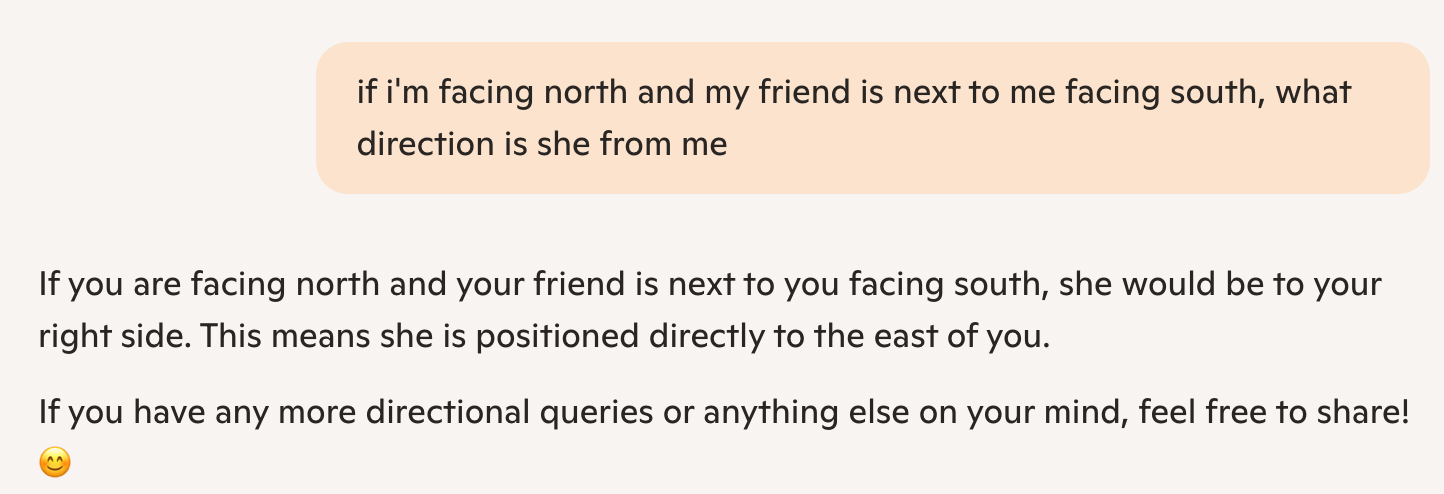
Notice that copilot fails to detect the other possible direction. It selects one but doesn’t recognize the other valid possibility. Humans find this grating like running fingernails over a chalkboard.
Let’s give it another chance with a follow up.
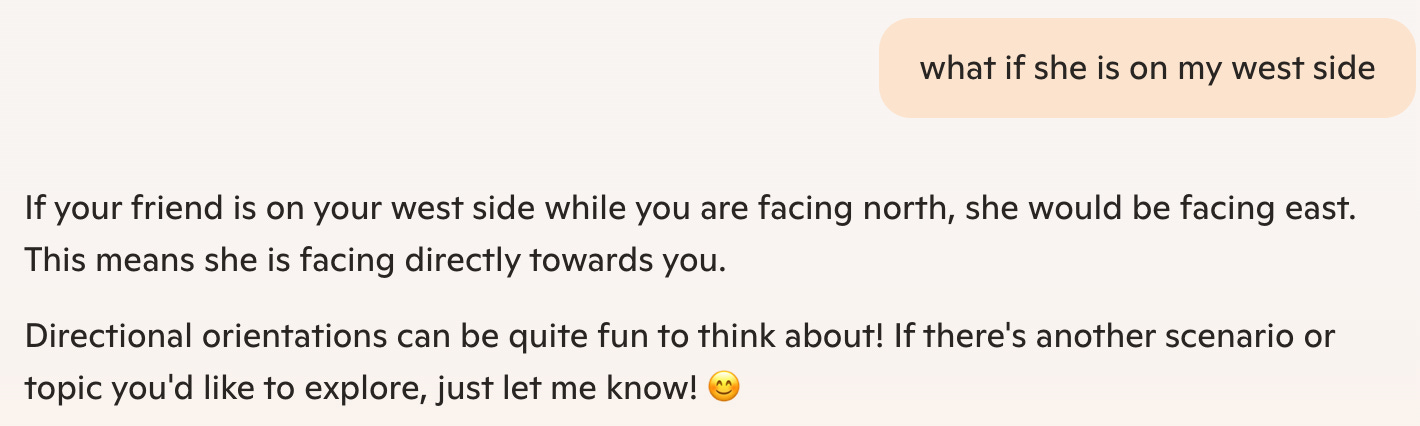
Human children easily deal with sentence fragments. In the case above, my fragment ‘what if she is on my west side’ should modify the original sentence: “if i'm facing north and my friend is next to me facing south, what direction is she from me” as:
if i'm facing north and my friend is on my west side facing south, what direction is she from me
The correct answer: “From me, she is on my West side.” I’m betting you got it.
Also how could it interpret this as my friend ‘facing directly towards me!’
Up next
In my upcoming video post, I’ll look at the biggest technical limitations of LLMs that will stop them ever becoming AGI without fundamental redesigns that deal with meaning, knowledge and the lack of scale ever possible in the foreseeable future. The human-like use of context, tracking current conversational elements while retaining reference to long-term memory elements is crucial for simple conversational tasks.