One of the most influential authors in my research has been Steven Pinker. I bought most of his books and worked through them with zest, creating endless notes on my quest to understand how our brain works.
Today, I look through some of the strengths and weaknesses of what I learned.
Along these lines, my distant cousin, the scientist Michael Faraday, once said:
“Nothing is too wonderful to be true, if it be consistent with the laws of nature.”
When the science is consistent with nature’s laws, a researcher easily becomes an industry expert, as the application of science enables engineering. But when the science is inconsistent, the expertise does not lead to successful engineering. The system doesn’t work!
My quest to emulate the human brain is littered with concepts that sound good in principle, but don’t work in practice. As I say, I know thousands of ways not to create Natural Language Understanding (NLU).
Trial and error incorporates the scientific model in which theory is set and tested for accuracy.
In this series, the limitations of the science from the 1940s to the present are discussed. Which concepts did not work, which ones did and why?
Part 1 recap
In my last article, Part 1 discussed the work of psychologist Robert Epstein from an article in 2016. Epstein pointed out that the brain:
‘does not process information, retrieve knowledge or store memories.’
His reasons are supported by an experiment in which people are asked to draw a one-dollar bill. They do not draw a perfect replica of a bill (as would be expected if the brain is storing a perfect symbol, like a photograph of the bill), but instead draw something that approximates the bill. This would be expected if the brain can recall a simpler version of the visual pattern for a bill, such as a simpler pattern that recognizes any dollar bill.
My brain model, known as Patom theory (PT), aligns with this approach in which the brain stores patterns once only per pattern, extracting commonalities from individual examples and consolidating all the possibilities in a hierarchy. The PT models comes from the analysis of brain damage and function.
Like most science, PT starts from observation to build a theory. But another approach, starting with an analogy and trying to fit it to observation, is the more popular one in the science of brain function over the past 2000 years.
Today's dominant large language or vision model approach is flawed because:
Neurons aren’t like logic gates. That’s a deceptive metaphor.
Memory isn’t stored in individual neurons, nor symbolically as snapshot recordings. The dollar example demonstrates decomposition to match ‘enough’ to accurately recognize objects, but not by storing entire images.
Patom Theory (PT) is an important breakthrough approach to move forward in cognitive science and brain replication. The PT model is unlike a computer:
Sensory recognition is made in interactions between the senses and layers of regions in the brain, each layer combining patterns from earlier ones
Senses connect together in ‘higher’ regions, eventually enabling multi-sense recognition
Recognition is primarily bottom-up with top-down confirmation in context (Hume’s impressions). Recall is primarily high-level patterns using reverse links in regions (Hume’s ideas).
Steven Pinker’s Computational Brain
It is no secret that Steven Pinker follows the analogy that the brain is a kind of computer. Of course, he isn’t proposing that it is like an IBM PC, but something that uses computation as would be seen in designs with logic gates (and, or, xor, nand, etc.). Let’s look at some quotes from two of his books: “How the Mind Works” and “Words and Rules: The Ingredients of Language” to see the focus on this metaphor.
Book 1: “How the Mind Works”
“How the Mind Works” is a 1997 book about the mind.
Study brains, not subjective minds
In Patom theory, the brain’s subjective side includes an awareness of its active senses. We are a multicellular being that subjectively experiences only a single being, which helps greatly in survival since the loss of any cells damages the being! The demonstration of the evolutionary age of awareness can be seen in the brainstem, which is common across fish, reptiles and mammals, including humans. In evolution, the brainstem is an early anatomical component suggesting awareness and therefore consciousness is an early function of brains, not a human-only capability.
In any case, PT would say that this book is about the subjective experience of a brain (the ‘mind’). Rather than studying subjective experience, PT focuses on brain function.
Artificial Intelligence (AI) has a problem known as Moravec’s Paradox. The paradox is summed up in Wikipedia’s extract for Pinker:
“Steven Pinker wrote in 1994 that "the main lesson of thirty-five years of AI research is that the hard problems are easy and the easy problems are hard".[4]
The paradox suggests that some kinds of AI are easy, like calculation, and others are hard, like motor-sensory manipulations. And yet, on the topic of what ‘intelligence’ is about, Pinker writes (P81):
“Another sign that the computational theory of mind is on the right track is the existence of artificial intelligence: computers that perform human-like intellectual tasks. Any discount store can sell you a computer that surpasses a human’s ability to calculate, store and retrieve facts, draft drawings, check spelling, route mail, and set type…”
Note that these examples are the easy problems for AI. The hard ones are uncited, like driverless cars and robotics! That’s why the computational theory is the wrong track!
Digital Computers Emulate Human Computers, not Brains
Digital computers emulate human computers! A human computer was a person who did calculations.
“Alan Turing described the "human computer" as someone who is "supposed to be following fixed rules; he has no authority to deviate from them in any detail."[2] Teams of people, often women from the late nineteenth century onwards, were used to undertake long and often tedious calculations; the work was divided so that this could be done in parallel. The same calculations were frequently performed independently by separate teams to check the correctness of the results.”
Computing was never designed to replace the human being’s senses and motor control, but instead to perform arithmetic and other tasks!
A design to recognize vision, for example, might be considerably simpler than today’s models—especially if the computational model isn’t forced into it.
Why are Natural Sciences Entrenched with Digital Computers?
Here’s an example from Pinker’s book (P83):
“The computational theory of mind has quietly entrenched itself in neuroscience, the study of the physiology of the brain and nervous system. No corner of the field is untouched by the idea that information processing is the fundamental activity of the brain.”
This raises the question of why industry and engineers like to adopt popular models, especially if they cannot predict results as scientific theories are intended to do.
The computational model is flawed! I’ve never seen a brain model based on computation that explains all the features of a human brain, especially the ability to learn on the fly and use new sensory information in real time. Equally, there is no feedback loop in today’s Generative AI between what is generated and a real-world model.
Patom theory takes a different approach, focused on finding ways that model what a brain does in real time and aligned with our observations of human capabilities. The bidirectional model is powerful here, because it aligns learning with what we have experienced and it also aligns recall with previous experience in the same context.
Book 2: “Words and Rules: The Ingredients of Language”
Pinker’s 1999 “Words and Rules” book explains many important observations about how languages work.
In any science, observation is an effective method to identify what happens. Theory, in contrast, proposes solutions to explain what happens. In the modern world as I’ve pointed out, there is a fixation on the computer metaphor to explain the human brain. If it were accurate, that would be good, but our inability to solve AI can be traced back to this metaphor.
Pinker wrote (P242):
The brain is the organ of computation and a computational system cares about how information flows within it...
Information is presumably some kind of encoded data, but the inputs to a brain are sensory in nature - vision, hearing, touch, balance and so on. Rather than this computer metaphor for information, PT uses the concept that senses detect patterns and refine them over time. The connections from multisensory patterns trace back to the set of sensory patterns that created it. This isn’t computation as we know it.
In PT, the appearance of symbols comes from the recognition of previously experienced entities that are tied together across the senses. Rather than encoded data in a computer, a brain uses its atoms of patterns, sort of like symbols, to associate with other experiences.
Further, Pinker continues with:
“A mental process is a set of computations in the millions of synapses of an intricately structured neural network.”
Well, I think this is speculation at best. A brain is doing something, for sure, but calling it a computation is seemingly unjustified. If our brain is activating neurons in regions, it is doing something that PT would perhaps call intersection, the identification of consistent patterns in the network. Intersection selects commonalities between multiple linkset patterns, which are patterns made of sets and lists. In other words, intersection limits possibilities to what is in context.
Why speculation? Because calling the neural activations ‘computations’ suggests that, like an ALU (algorithm logic unit), they are performing some kind of instruction within a programmed sequence of steps. The anatomy of brain regions and their functions don’t support an alignment with an ALU.
To program that capability is insanely complex, evidenced by our inability to do it.
I suggest removing the bias towards information processing and computation will help clarify what is going on in brain science, at least until an accurate description of what is going on is observed and accepted.
PT’s analysis using brain regions is more effective as a metaphor for what is going on. Perhaps pattern matching for accurate recognition and recall is being checked for consistency as predicted by Patom theory. The idea that millions of synapses are set up to compute like an ALU seems daunting at least, and unlikely at worst. How would it be set up to function properly for some arbitrary work?
Book 2: Connectionist limitations
In science, prizes often go to the first discoverer. Which is why, when reading Pinker’s Words and Rules, I found the way it described an important discovery strange (P.266). Our brains use different regions to produce the past tense forms of regular, irregular and nonce verb stems. It was strange to me that the first authors were not mentioned in the text, only in a footnote.
Why?
Perhaps the fact that this was a very unpopular discovery. A contrary result to the connectionist model that was very popular at the time, in academia! Maybe I’m sensitive to this, but Pinker’s written words are:
“I had planned such an experiment with one of the major PET research centers, but others had the idea too, and we were scooped by four different labs.”
I think Pinker was scooped by Jaeger’s team, linked below, and that discovery was followed by three more similar experiments. The paper I refer to came from Jaeger et al. called A Positron Emission Tomographic Study of Regular and Irregular Verb Morphology in English. It also included the upsetting conclusion for many connectionist researchers (P.488):
“We found that subjects produced the past tense forms of regular verbs significantly faster than irregular … with … nonce forms being more similar to regular verbs. Error rates for irregular verbs were considerably higher than error rates for regular or nonce past tense forms. The irregular past task elicited significantly larger areas of brain activation at higher degrees of significance than did the regular past task. While there were some areas of overlap in the two images, there were several areas activated in each task that were not activated in the other. Taken together, theses finding strongly support the dual-systems hypothesis that regular and irregular past tense forms in English are computed by different mechanisms; they are not compatible with single-system theories which hypothesize that both regular and irregular past tense forms are computed by the same mechanism.
As an aside, I asked one of the authors, Robert D. Van Valin, Jr. who was a part of that study, why the language used included ‘computation’ in: “…both regular and irregular past tense forms are computed by the same mechanism.” He said that’s how everyone spoke in those days. I realize there is work to do to change the default model to one of pattern matching! In any case, that was written nearly thirty years ago.
But for science to progress, limitations in the best scientific hypotheses can be addressed with better models or removed from consideration. The results were highly controversial, despite following a standard scientific approach. And from my perspective, these observations strongly support Patom theory.
In PT, there are two kinds of patterns - (a) snapshots, like a photograph of active pixels and (b) sequences, like a list of patterns made up of sets and sequences. So, briefly, in the case of regular verbs like ‘pull’ and ‘pulled’ versus irregular verbs like ‘fall’ and ‘fell’ versus nonce verbs like ‘baff’ and ‘baffed’, there are a few patterns at play.
The regular forms use a sequential pattern, effectively, ‘verb + ed.’ So do the nonce forms. But irregular forms can replace parts of the words like ‘fall’ and ‘fell’ and ‘think’ and ‘thought’, or use a different suffix like ‘eat’ and ‘eat + en.’ If pattern sequences of word parts are stored in different brain locations, that would explain the different regions seen in the PET results. Variation in the model would depend on the language, of course.
PT explains regular and irregular forms as learned patterns. If we use a sequence, our brain stores that. If we use a different kind of replacement, our brain finds that when it doesn’t find a stored sequential form, making it take longer. The brain connects the different parts together to recognize the group as a symbol—what we call a ‘word.’
PT provides a theoretical approach to neuroscience. The complete solution to problems such as these needs to be probed further with experiments to test the PT hypothesis against the observations using tools like fMRI and PET.
Conclusion
This article explains why the information processing model appears to be the wrong one to explain brains. It came from the emulation of human computers doing particular tasks and is extremely effective and flexible at those kinds of tasks.
Moravec’s Paradox identifies a different problem, that easy things are hard in AI (sensory recognition and motor control) and hard things are easy (memorizing millions of database records).
Simply removing our reliance on the processing metaphor offers many benefits for improved brain emulation, such as those suggested by Patom brain theory.
Do you want to get more involved?
If you want to get involved with our upcoming project to enable a gamified language-learning system, the site to track progress is here (click). You can keep informed by putting your email to the contact list or add a small deposit to become a VIP.

Do you want to read more?
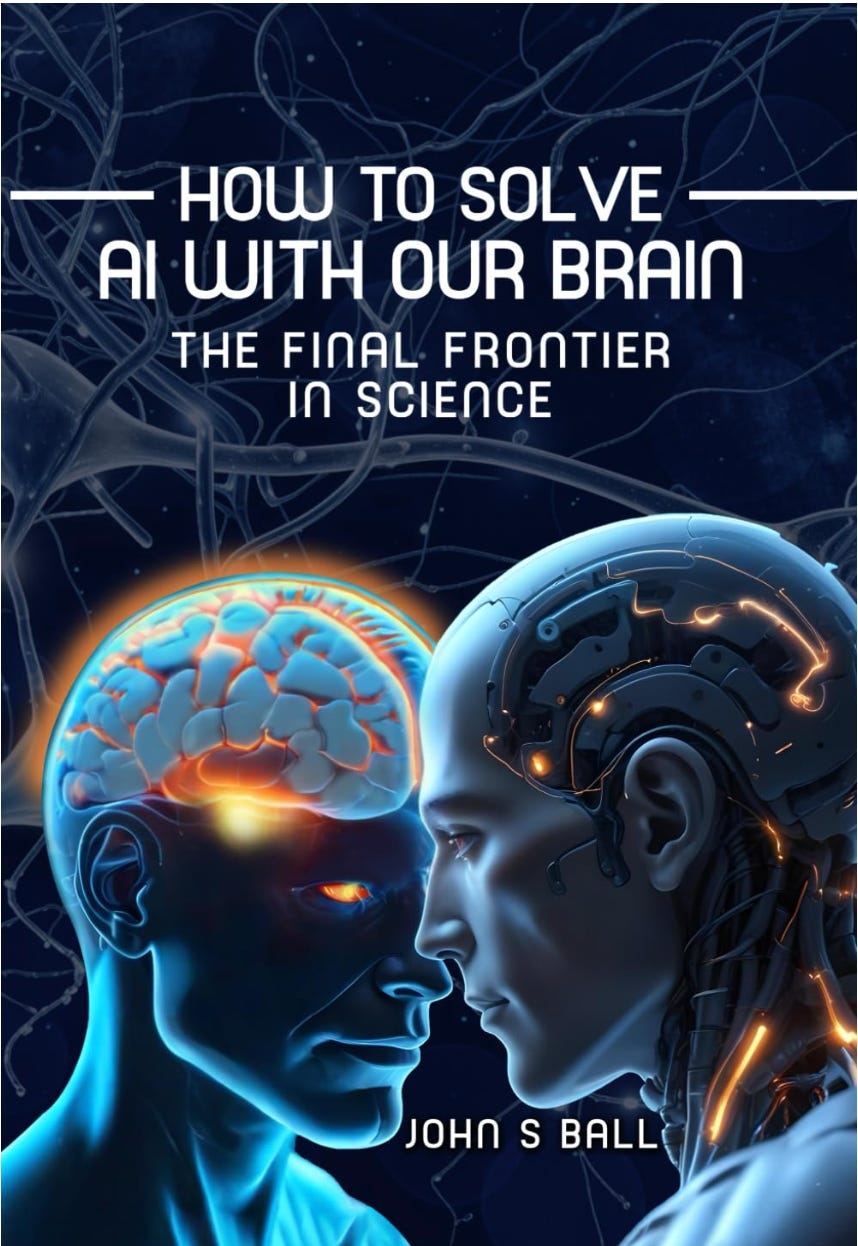
If you want to read about the application of brain science to the problems of AI, you can read my latest book, “How to Solve AI with Our Brain: The Final Frontier in Science” to explain the facets of brain science we can apply and why the best analogy today is the brain as a pattern-matcher. The book link is here on Amazon in the US (and elsewhere).
In the cover design below, you can see the human brain incorporating its senses, such as the eyes. The brain’s use is being applied to a human-like robot who is being improved with brain science towards full human emulation in looks and capability.